

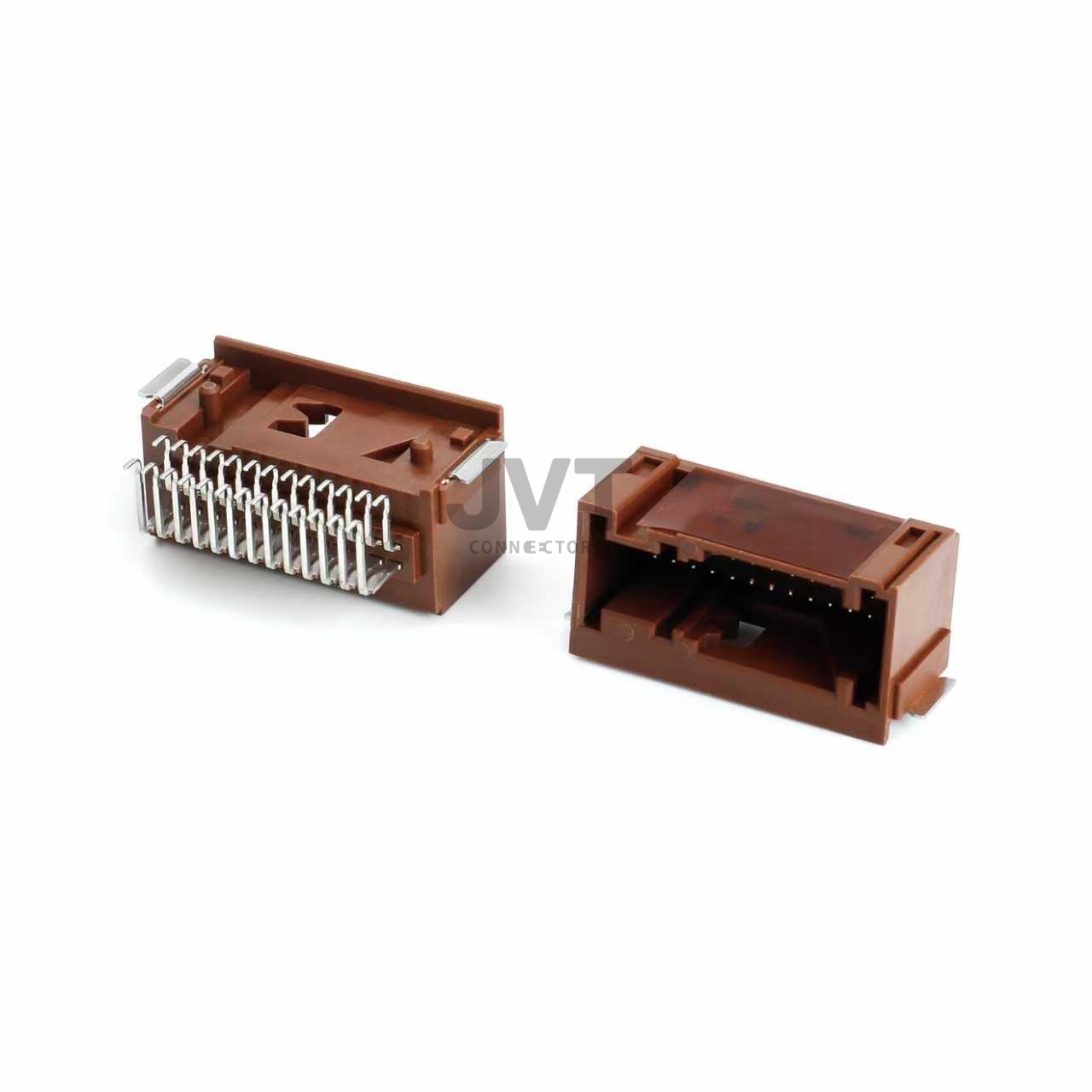
An air conditioner PCB connector is one of those parts nobody notices until the production line stops. On an indoor unit controller, it carries the fan motor feedback, the room and coil temperature sensors, the louver drive, and the communication link to the outdoor unit, all on a board that has to fit behind a plastic cover about as thick as a finger. When an air conditioning and fresh air equipment manufacturer reviewed a high volume controller program, the part that kept them tied to an overseas supplier was an imported 2.54 mm wire-to-board connector, and the constraint was simple: the replacement had to drop into the existing footprint.
This case study explains what that board actually requires, why a 2.54 mm family is still the right answer on a modern appliance, how the cross-reference was evaluated, and what the program reported afterwards. It is written for engineers and buyers specifying connectors for air conditioning, ventilation, and other high volume appliance controllers.
What This Air Conditioner PCB Connector Has to Carry
A residential indoor unit is a multi-signal board. The connector at the heart of it is doing several jobs at once, and each one has a different reliability story.
- Motor and sensor signals. Low current, but continuous. A drifting sensor reading is what produces the customer complaint about a unit that cools too long or too little, and a poor contact introduces exactly that kind of drift.
- Actuator and louver drive. Higher inrush than steady current, and switched frequently. The connector sees current pulses every time the louver moves.
- Service and assembly. The harness is fitted on a fast line, and the same interface is opened during field service. Retention and keying matter more than they look on a drawing.
Because the board sits in a condensation-prone environment, the plastic materials also have to meet the appliance safety expectations for flame performance and the material declarations that the air conditioner brand ships with its product.
Why a 2.54 mm Family Still Wins on Appliance Boards
It is fashionable to shrink pitch, and on a dense logic board that is the right instinct. An indoor unit controller is not that board. It has plenty of room behind the cover, the harness carries currents that a 1.5 mm pitch terminal would handle only uncomfortably, and the assembly line is tuned to a 2.54 mm crimp and a 2.54 mm housing that every operator already knows.
There is also a service argument. A 2.54 mm interface is easier to inspect and easier to re-terminate in the field, and on a product that is repaired rather than discarded, that has value. The usual imported references in this space are the JST XH and VH families, which is exactly what our customer's design had specified.
The cross-reference check we ran first
Before quoting, we compared the customer's imported part against our 2.54 mm pitch series on the three things that decide whether a substitution is practical: contact pitch and position count, the drill and pad pattern on the board, and the housing envelope including the latch. Where those match, the customer can keep the PCB, the harness drawing, and the assembly fixture.
Second source without a second design
The customer's real goal was not to redesign the board. It was to keep a qualified second source available for a part that sits on a high volume line, so that a supply interruption does not stop air conditioner production. That is a procurement objective, and a cross-referenced connector made in our own tooling addresses it directly.
Volume tooling and repeatability
On a program of this size, tooling life and process repeatability matter as much as the first article. Our stamping and injection capacity is sized for high volume appliance work, which is why the program could be planned around monthly shipments rather than around batch production.
Interface configuration for this program
Connector family: JVT25403 series on 2.54 mm pitch, cross-referenced against the customer's existing JST XH and VH part numbers.
Signals carried: motor feedback, room and coil sensor inputs, louver drive, and indoor to outdoor communication wiring.
Board impact: no layout revision required, since the footprint was matched during the cross-reference review.
Supply mode: high volume production shipments for a manufacturing program that runs continuously.
What the Program Reported
The figures below are the ones reported for this air conditioning program. They describe this design and this supply arrangement.
| Item | Imported part | JVT25403 series |
|---|---|---|
| Board footprint | JST XH and VH pattern | Matched, no layout change |
| Unit price in that project | Baseline | More than 30 percent lower |
| Supply model | Single overseas source | Domestic source with production capacity behind it |
| Harness drawing | Existing | Unchanged |
| Shipment pattern | Batch orders | High volume repeated shipments |
The customer kept the imported part number in the drawing as an approved alternative for a transition period, which is standard practice on a high volume line, and then retired it once the domestic supply had run across several production cycles without an issue.
How to Validate a Cross-Referenced Connector Before Release
A cross-reference is not a paperwork exercise. On a program like this one, the usual sequence runs through six checks before the new part number goes into the drawing as an approved source, and each of them exists because of a failure someone has seen before.
The first is a dimensional check against the original drawing, covering pitch, row spacing, position count, and the post or pad pattern. The second is a plating check on incoming samples, because plating thickness is the parameter most likely to differ between an original part and a substitute. The third is a crimp evaluation: pull-out force measured on the customer's own wire gauge and insulation type, not on a wire chosen by the supplier. The fourth is mating and unmating force, which determines whether the harness will feel normal to the operator and whether the housing will survive repeated service. The fifth is a retention check under vibration, and the sixth is a pilot run on the production line, where the harness is built with real tooling and real cycle times.
The customer owns the final qualification decision, because the customer owns the product. What we provide is the evidence needed to run those six checks without waiting for overseas samples, and a set of drawings detailed enough to record the alternative part in the Bill of Materials. That last point matters more than it sounds. When the drawing notes an approved alternative instead of a single source, a supply interruption becomes a purchasing problem rather than an engineering project.
Why Choose JVT as Your Long-Term Interconnect Partner?
JVT is the brand of Dongguan JVT Connectors Co., Ltd., a connector manufacturer established in Dongguan, Guangdong in 2006 with a 6,500 square metre plant and a branch in Wujiang, Jiangsu. We make connectors rather than trade them: injection moulding, stamping, and automatic pin insertion all run in our own factory, with more than twenty injection moulding machines, more than twenty stamping presses, and more than fifty automatic pin insertion machines behind them. Our management systems are certified to ISO 9001, ISO 14001, IECQ QC080000, and IATF 16949, and our products are tested by UL and SGS.
Our pitch range spans nineteen steps from 6.35 mm to 0.60 mm, and our product families include wire-to-board, wire-to-wire, board-to-board, IDC, pin header, DC connectors, board-in terminals, FFC/FPC, and the terminal series. Application ranges cover automotive, low-altitude flight, lithium battery 3C, power tool, power module, industrial, consumer, new energy, home appliances, and computer products, with shipments to North America, Europe, the Middle East, India, Brazil, Korea, Turkey, Malaysia, Canada, and the United States among others.
For air conditioning and ventilation boards, the useful starting points are the 2.54 mm pitch series used in this program, the home appliance connector range for the rest of the controller, and the wider wire-to-board connector catalogue for multi-position signal interfaces.
Frequently Asked Questions About the Air Conditioner PCB Connector
Can a JVT25403 connector replace JST XH or VH parts directly?
It can where the footprint, position count, pitch, and latch geometry match your existing design. We run that comparison before quoting, and we supply drawings and samples so your team can confirm equivalence on your own board. JVT is an independent manufacturer and not an authorised distributor of any imported brand.
Should an air conditioner controller use a finer pitch?
Only if board area is genuinely constrained. On an indoor unit controller there is usually room behind the cover, the harness carries actuator inrush current, and the production line is already set up for 2.54 mm crimps. Moving to a finer pitch adds cost and re-tooling for a benefit the mechanical envelope does not require.
Why does a temperature sensor signal drift over time?
In a cycling appliance, contact resistance at the connector interface is one of the usual suspects, along with terminal oxidation and mechanical relaxation. A stable plated contact with consistent normal force is what keeps the reading repeatable across thousands of thermal cycles.
What volume can JVT support on an appliance program?
Appliance work is a core part of our production. Our stamping and injection capacity is sized for continuous high volume programs, and monthly shipment schedules are the normal arrangement rather than a special case.
Do I need new tooling to change supplier?
Usually not for the harness side, since the wire is crimped onto our terminals with standard tooling. Where a custom housing is required, tooling is developed in our own mould shop, which is also why a modified latch or keying is a practical request rather than a project.
If a single overseas part number is holding your air conditioner line to a schedule you cannot control, an air conditioner PCB connector cross-reference takes a week, not a redesign. Send us the drawing and the annual volume, and we will tell you whether the 2.54 mm family drops straight in.
View the 2.54 mm Pitch Series Request a Cross-Reference Check